DDR6 RAM Prices in 2026: Why Your Next Memory Upgrade Costs $650 More [Breakdown]
RAM prices are surging in 2026 thanks to a perfect storm of DDR6 manufacturing challenges, AI-driven HBM demand, and an oligopoly that controls over 90% of the market. Here's the technical breakdown.


DDR6 RAM Prices in 2026: Why Your Next Memory Upgrade Costs $650 More [Breakdown]
A 32GB DDR5 kit cost around $80 in late 2024. Today, equivalent DDR5 kits are trending past $130, and early DDR6 modules are projected to land well above that. If you're planning a PC build in 2026, your DDR6 RAM prices alone could run you $400-650 more than a comparable DDR5 setup did just eighteen months ago. This isn't normal market fluctuation. It's manufacturing economics, AI-driven demand shifts, and the reality of how memory actually gets made all slamming into each other at once.
I've been watching hardware costs closely since building out local AI inference rigs last year, and the memory market right now feels like 2020 GPU pricing all over again. Except this time, the forces driving it are structural. They're not going away when a crypto winter hits.
Let me break down exactly what's happening.
Why Are DDR6 RAM Prices So High in 2026?
Three things hit at once, and none of them are going away soon.

First, the DDR6 transition itself. Every new memory generation carries an early-adoption tax. DDR6 is a massive leap in signaling technology. According to TrendForce, the market research firm that tracks semiconductor pricing, DDR6 speeds are projected to start around 8,800 MT/s and potentially reach 17,600 MT/s. That's roughly double early DDR5 modules. Getting there requires new substrate materials, more complex packaging techniques like Modified Semi-Additive Process (MSAP), and entirely retooled production lines.
New production lines mean low yields. In semiconductor manufacturing, yield is everything. When Samsung, SK Hynix, and Micron spin up DDR6 fabrication, they're dealing with first-generation processes where a big chunk of chips coming off the line don't meet spec. Those failed chips aren't free. Their cost gets baked into every module that does work. I've watched this same dynamic play out with every major hardware transition. Early DDR5 had the same problem in 2022, but DDR6's technical demands are substantially more aggressive.
Second, the DRAM market is an oligopoly. Samsung, SK Hynix, and Micron control over 90% of global DRAM production. That's not a competitive market. That's three companies making coordinated production decisions. As Chris Szewczyk, Hardware Writer at PC Gamer, documented in his analysis, these manufacturers deliberately cut DRAM production in late 2023 and early 2024 to end a period of oversupply and push prices back up. Not a conspiracy theory. A documented business strategy that repeats every few years.
Third, and this is the one most people miss: AI ate your RAM budget. More on that below.
The AI Demand Problem Nobody's Pricing In
Here's the thing nobody's saying about DDR6 RAM prices: the biggest threat to affordable consumer memory isn't consumer demand at all. It's enterprise AI.
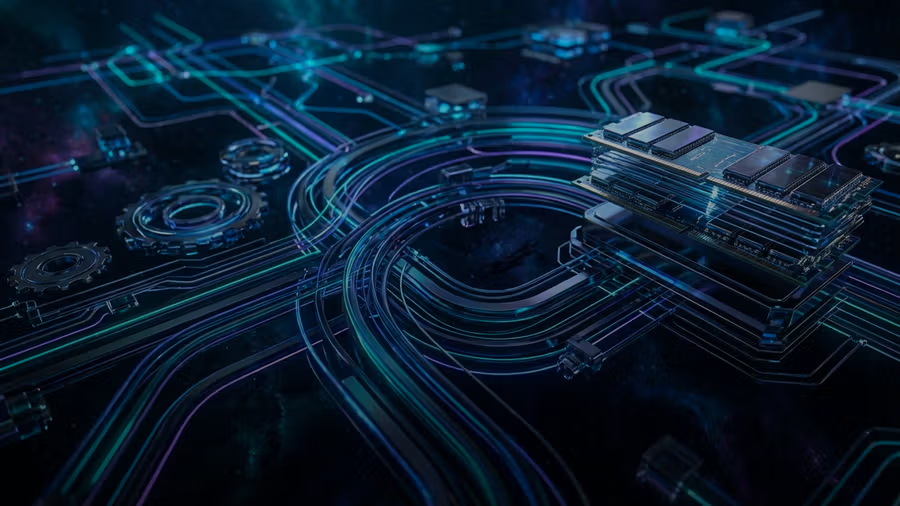
Every major AI accelerator — NVIDIA's H100 and B200, AMD's Instinct MI300X — requires massive amounts of High-Bandwidth Memory (HBM). HBM is fabricated on the same wafer production lines as consumer DRAM. When Samsung Semiconductor talks about the role of AI in memory's future, they're describing a world where HBM demand for AI training and inference is eating an ever-larger share of fab capacity.
Think about it this way: a single NVIDIA B200 GPU uses multiple HBM3E stacks, each requiring dozens of DRAM dies. A hyperscaler ordering thousands of these GPUs represents a massive pull on the same silicon wafer supply that would otherwise become your DDR6 desktop kit. Hyperscalers pay premium prices with long-term contracts. Consumer memory gets whatever's left.
I wrote about this dynamic in a different context when looking at how the helium shortage is squeezing the semiconductor supply chain. The pattern is identical: when a critical input gets diverted to higher-margin products, consumer pricing absorbs the pain. Having worked with infrastructure teams provisioning AI workloads, I can tell you the appetite for HBM shows zero signs of slowing. If anything, it's accelerating as more companies move from AI experimentation to production deployment.
If you're mapping these cost pressures to your own stack, the same “who gets priority” question shows up in tooling and developer workflows too. I dug into that angle in Claude Code Security [2026]: Risks, Safe Setup, Team Policy.
The DRAM market doesn't have a demand problem. It has a prioritization problem. AI workloads pay more per gigabyte, so consumer memory gets squeezed.
How Does the DRAM Manufacturing Oligopoly Affect Prices?
Michael Crider, Contributor at How-To Geek, has written extensively about the cyclical nature of RAM pricing and the role the Big Three play. The core insight is dead simple: when three companies control the entire supply of a commodity with inelastic demand, prices don't behave like a normal market.
Here's the cycle, and it repeats like clockwork:
- Oversupply phase: Manufacturers ramp production aggressively. Prices crater. Consumers celebrate cheap RAM.
- Margin squeeze: Low prices hurt profitability. Manufacturers announce production cuts.
- Supply contraction: Reduced output meets steady or growing demand. Prices climb.
- Price peak: Fat margins. Eventually they ramp production again.
- Repeat.
We've watched this play out at least four times since 2012. The difference in 2026 is that step 3 now includes a structural demand shift — AI and HBM — that wasn't present before. Production cuts aren't just about managing inventory anymore. They're about reallocating capacity toward higher-margin products.
This is one of those things where the boring answer is actually the right one. RAM prices aren't high because of some exotic supply chain disruption or geopolitical crisis. They're high because the three companies that make all the world's DRAM have rational economic incentives to keep them high. And now they have an additional reason (AI demand) to divert capacity away from consumer products.
For anyone who followed the Raspberry Pi supply chain chaos, the dynamic is familiar. When industrial and enterprise buyers compete with consumers for the same components, consumers lose. Every time.
The DDR6 Manufacturing Tax: What's Actually Different This Time
Every memory generation transition comes with a cost premium. DDR6's technical requirements push that premium higher than what we saw with DDR4-to-DDR5.
The manufacturing challenges driving costs up:
- Signal integrity at 8,800+ MT/s demands new PCB substrate materials that cost more per unit area than standard FR-4. This alone adds meaningful cost per module.
- MSAP packaging allows finer trace widths needed for DDR6 speeds, but the process is more complex and slower than traditional subtractive etching.
- On-die ECC becomes mandatory. More transistors, more die area, fewer usable chips per wafer.
- Power management complexity goes way up. DDR6 requires more sophisticated voltage regulation on both the module and motherboard side.
- Testing and validation takes longer because higher speeds mean tighter margins for error. Every module needs more rigorous binning.
All of this stacks up to a manufacturing cost premium estimated at 40-60% over equivalent DDR5 modules, before you even factor in the supply-demand dynamics above. Early DDR5 adopters in 2021-2022 paid roughly a 30-40% premium over DDR4. DDR6's premium is steeper because the technical jump is larger.
I've shipped enough systems to know that early-generation hardware pricing is almost never worth it for individual consumers. The value proposition of DDR6 at launch speeds isn't dramatically different from high-end DDR5 for most workloads. The performance gains become compelling at the higher speed tiers arriving 12-18 months after initial release. By then, yields will have improved and prices will have come down.
Should You Buy DDR5 Now or Wait for DDR6?
This is the practical question. I'll give you a direct answer: if you're building a PC in 2026, buy DDR5.
DDR5 is a mature technology now. Yields are high, competition among module makers (not just DRAM manufacturers, but companies like Corsair, G.Skill, and Kingston that assemble kits) is healthy, and speeds have reached a point where 6,400-7,200 MT/s kits offer genuinely excellent performance. DDR6 at launch will be faster on paper, but the real-world performance difference for gaming, development work, and general productivity will be marginal at best.
If you're building an inference rig for local AI work, memory bandwidth matters more, and DDR6 will eventually be compelling for that use case. But "eventually" means late 2027 at the earliest for reasonable price-to-performance.
The math changes if you're an enterprise buyer or a researcher who needs maximum memory bandwidth and can amortize the cost across productive workloads. For everyone else, the DDR6 early-adopter tax is real and not worth paying.
What Happens Next
DRAM pricing will stay elevated through at least mid-2027. DDR6 ramp-up costs, sustained HBM demand from AI infrastructure buildout, and the oligopoly's natural incentive to maintain pricing discipline — there's no quick relief coming.
What makes this cycle different from previous ones is AI. Previous DRAM price spikes were driven by smartphone demand or cryptocurrency mining, both of which proved cyclical. AI memory demand looks more permanent. As long as companies are training and deploying large models, HBM will compete with consumer DRAM for fab capacity. And everything in JEDEC's standards roadmap suggests future memory generations will only deepen this entanglement between AI and consumer memory markets.
My prediction: DDR6 pricing follows a steeper version of the DDR5 curve. Prices drop roughly 15-20% per year after launch, reaching mainstream affordability by early 2028. Until then, the smart money is on riding DDR5 as long as your platform supports it. The builders who wait will be rewarded. The ones who chase bleeding-edge specs in 2026 will pay the kind of premium that makes $650 look conservative.
The memory market has always been cyclical. What's new is that the cycle now has a structural floor set by AI demand. Plan accordingly.
Photo by Shavr IK on Unsplash.
Continue reading

Raspberry Pi Price Hikes in 2026: Why Your Homelab Just Got More Expensive (and 3 Alternatives)
Raspberry Pi prices keep climbing in 2026. Here's the semiconductor economics behind the increase, whether you should buy now or wait, and three practical alternatives for your homelab.
Intel Arrow Lake vs AMD Ryzen 9000: Intel's Budget Problem Still Isn't Solved [2026]
Intel launched Arrow Lake on expensive LGA 1851 with flagship-first pricing. Even after the non-K parts arrived, AMD's AM5 platform still dominates the value tiers. Here's what that means for your next build.
Verify GGUF Model Hashes Supply Chain [2026]: 10 Steps
A team-ready workflow to verify GGUF integrity: compute SHA256, require signed manifests, handle mirrors safely, scan sidecars, and ship updates via an internal registry.
![nvidia gpu graphics card close-up — illustration for article on Local LLM Break-Even Math [2026]: Power,](https://img.kunalganglani.com/images/vzekdneq/production/76beafb78b6f19b7ed6235232857078a023801c2-1200x675.webp?auto=format&fit=max&q=75&w=500)
Local LLM Break-Even Math [2026]: Power, Idle, Depreciation
Most “GPU price ÷ tokens” break-even math is wrong. Here’s a spreadsheetable local LLM total-cost model that includes idle power, utilization, depreciation, failures, and opportunity cost.

Kunal Ganglani (2026, April 4). DDR6 RAM Prices in 2026: Why Your Next Memory Upgrade Costs $650 More [Breakdown]. Kunal Ganglani. Retrieved October 3, 2026, from https://www.kunalganglani.com/blog/ddr6-ram-prices-2026
Frequently Asked Questions
What is the latest DDR6 news in 2026?
In 2026, DDR6 is arriving with significantly higher launch prices than DDR5, driven by three overlapping forces: the manufacturing complexity of a new memory generation starting at 8,800 MT/s, deliberate production cuts by Samsung, SK Hynix, and Micron, and AI-driven HBM demand consuming fab capacity. Early DDR6 modules are projected to cost $400–650 more than a comparable DDR5 setup did just eighteen months ago.
What is the DDR6 RAM release date and status in 2026?
DDR6 RAM is in early release in 2026, but it remains an expensive early-adopter product rather than a mainstream option. Initial modules are hitting the market with a 40–60% manufacturing cost premium over DDR5, driven by low production yields on first-generation DDR6 fabrication lines. Mainstream availability at reasonable prices is not expected until late 2027 or early 2028.
What is the current DDR6 RAM price in 2026?
Early DDR6 modules in 2026 are projected to land well above the $130 that equivalent 32GB DDR5 kits are already trending toward, with a full DDR6 setup potentially costing $400–650 more than a comparable DDR5 build did in late 2024. The premium reflects low manufacturing yields, new substrate materials, and fab capacity being diverted to higher-margin AI memory products.
What is the DDR6 RAM availability in 2026?
DDR6 RAM is technically available in 2026 but in limited supply, as Samsung, SK Hynix, and Micron are still ramping first-generation production lines while simultaneously prioritizing High-Bandwidth Memory output for AI accelerators. The supply squeeze means consumers are competing for whatever fab capacity remains after enterprise AI orders are filled, keeping DDR6 inventory tight and prices elevated.
What is the DDR6 memory release status in 2026?
DDR6 memory has entered the market in 2026 but is not yet at a stage where most PC builders should seriously consider it. Speeds are projected to start around 8,800 MT/s and scale to 17,600 MT/s, but early yields are low and manufacturing costs are high, placing DDR6 firmly in early-adopter territory. Broad consumer viability is expected in early 2028 as yields improve and production scales.
What are DDR6 RAM prices expected to be?
DDR6 RAM prices are expected to decline roughly 15–20% per year after launch as manufacturing yields improve, but meaningful affordability is unlikely before early 2028. The decline will likely be slower than previous memory generations because AI-related HBM production continues to consume a large share of the same fab capacity that makes consumer DDR modules, creating a structural pricing floor that wasn't present in past DRAM cycles.