Raspberry Pi Price Hikes in 2026: Why Your Homelab Just Got More Expensive (and 3 Alternatives)
Raspberry Pi prices keep climbing in 2026. Here's the semiconductor economics behind the increase, whether you should buy now or wait, and three practical alternatives for your homelab.


The Raspberry Pi 4 Model B launched at $35 for its 2GB variant in 2019. Today, the equivalent Raspberry Pi 5 with 2GB costs $50. The 4GB model? $60, up from the Pi 4's $55. And if you want 8GB, you're looking at $80. Add a case, power supply, and an NVMe HAT, and your "budget" single-board computer is pushing $150. The era of the Raspberry Pi as a cheap homelab foundation is over. Raspberry Pi price hikes in 2026 are really a story about semiconductors, geopolitics, and the slow death of cheap computing.
I've been running Pi-based infrastructure in my homelab for years. DNS servers, container hosts, lightweight monitoring dashboards. The appeal was always the price-to-utility ratio. That ratio has fundamentally shifted, and it's not coming back.
The Raspberry Pi isn't dead, but the Pi-as-default-homelab-hardware era is over. Once a kitted Pi 5 hits $150, used enterprise mini PCs win.
Why Are Raspberry Pi Prices So High in 2026?
The short answer: Raspberry Pi isn't a charity. It's a publicly traded company now.
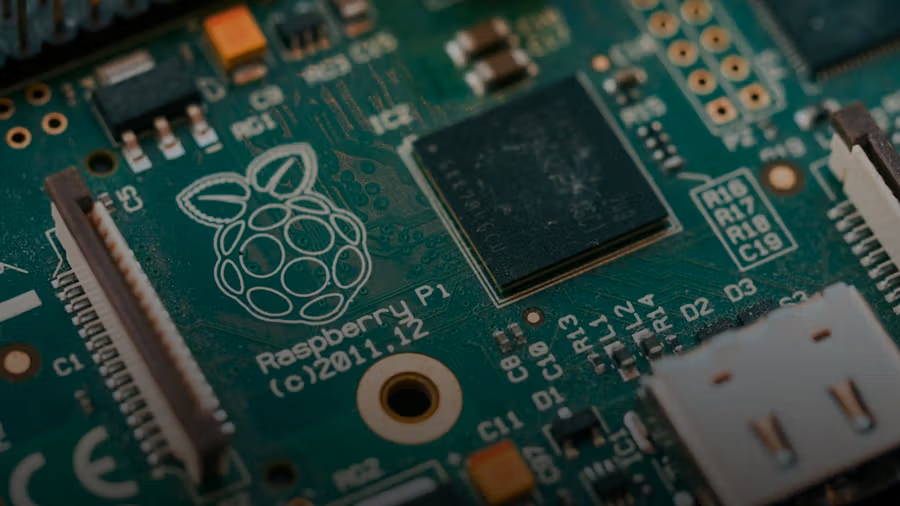
Raspberry Pi Holdings went public on the London Stock Exchange in June 2024, raising approximately £166 million. That IPO changed everything. Public companies answer to shareholders who expect margins, not hobbyists who expect $35 boards forever. Eben Upton has been transparent about the fact that the Pi 5's custom silicon (the RP1 southbridge chip) required serious R&D investment that gets amortized into unit pricing.
But the IPO alone doesn't explain it. Three structural forces are pushing prices up:
1. Custom silicon costs money. The Pi 5 uses a Broadcom BCM2712 SoC and Raspberry Pi's own RP1 I/O controller. Designing custom chips isn't something you do on a hobbyist budget. The RP1 alone took years of development. Every generation of Pi that moves further from commodity parts adds cost.
2. DRAM pricing is brutal right now. Memory prices are cyclical, and 2025-2026 hit an upswing. According to TrendForce's Q1 2025 DRAM pricing report, contract prices for DDR4 and LPDDR4X increased 8-13% quarter-over-quarter through the first half of 2025. The reason? AI server demand is consuming an outsized share of global memory production. When hyperscalers are buying every DRAM chip they can get, small-volume buyers like Raspberry Pi pay more.
3. Tariffs and trade friction. The boards are manufactured by Sony's facility in Pencoed, Wales, but components come from across Asia. Ongoing US-China trade tensions and European supply chain regulations have increased the cost of sourcing. As I covered in my post on the helium shortage and semiconductor supply chain, the knock-on effects of constrained raw materials ripple through the entire electronics industry.
Every new Pi generation costs more than the last. And the gap between "Pi price" and "actual usable system price" keeps widening.
Is the Raspberry Pi 5 Still Worth Buying?
It depends on what you're building. Full stop.
The Pi 5 is genuinely impressive hardware. The BCM2712's quad-core Cortex-A76 at 2.4GHz is a real step up from the Pi 4's Cortex-A72 cores. PCIe 2.0 x1 means you can finally attach an NVMe drive without USB bottlenecks. For GPIO-dependent projects, robotics, camera pipelines, anything that needs the Pi's specific ecosystem of HATs and accessories, there's still nothing quite like it.
But if you're using a Pi as a generic Linux server in your homelab? Running Pi-hole, Home Assistant, or a small Docker stack? The value proposition has fallen apart. A fully kitted Pi 5 with 8GB RAM, NVMe storage, case, and power supply runs $130-150. At that price, you're competing with very different hardware.
I've shipped enough homelab configurations to know that the Pi's real advantage was never raw performance. It was the combination of low power draw (5-7W under load), a massive community, and a price low enough that you didn't think twice about dedicating one to a single task. At $150 per node, you start thinking twice. And once you're thinking twice, the alternatives look very attractive.
Best Raspberry Pi Alternatives for Your Homelab in 2026
Three alternatives are worth your attention, each for a different reason.
Orange Pi 5 Plus
The Orange Pi 5 Plus runs a Rockchip RK3588 with 8 Cortex-A76 cores and up to 32GB of RAM. Dual 2.5GbE, M.2 NVMe, and an NPU capable of 6 TOPS. The 16GB model runs about $120, which gives you way more compute per dollar than a Pi 5.
The catch: software support. The Orange Pi ecosystem is nowhere near as polished. You'll spend more time wrangling drivers and kernel configs. Armbian helps, but forget about the plug-and-play experience of Raspberry Pi OS. If you're comfortable with Linux and don't mind rough edges, this is the best performance-per-dollar play in the SBC market right now.
Used Enterprise Micro PCs
Here's the thing nobody's saying about homelab hardware: the best deal isn't a single-board computer at all.
A used Lenovo ThinkCentre M720q Tiny or HP EliteDesk 800 G5 Mini with an Intel Core i5, 16GB DDR4, and a 256GB NVMe goes for $80-120 on eBay. Same price as a kitted-out Pi 5. Dramatically more compute power. Native x86 compatibility (no ARM headaches). ECC memory support on some models.
Yes, power consumption is higher. These mini PCs draw 15-35W under load versus the Pi's 5-7W. For a single node, the electricity cost difference is barely noticeable. For a cluster of 5+, it starts to matter. But for most people running a homelab, x86 compatibility alone is worth it. No more hunting for ARM-compatible Docker images or fighting with cross-compilation.
This is one of those things where the boring answer is actually the right one. The used enterprise market is flooded with perfectly capable machines that companies are replacing on 3-year refresh cycles. Your homelab's gain is some corporation's depreciation schedule.
Radxa ROCK 5B
Another RK3588-based board, the Radxa ROCK 5B sits in the middle ground. Better mainline Linux kernel support than the Orange Pi, a more active community, similar specs. The 16GB model is around $130. If you want an SBC specifically (small form factor, GPIO access, low power) but don't want to pay the Pi tax, Radxa is worth evaluating.
Will Raspberry Pi Prices Go Back Down?
No. Not in any meaningful way.
The Raspberry Pi Foundation's original mission was education. Making computing accessible to kids who couldn't afford a desktop. That mission is real and important, and it's still served by the Pi Zero 2 W at $15 and the Pico at $4. But the flagship Pi line has moved decisively upmarket.
As a public company, Raspberry Pi Holdings has every incentive to push toward higher-margin products. The Raspberry Pi AI Kit, the Compute Module 5 for industrial applications, the Pi 500 keyboard computer. These are products targeting commercial and prosumer buyers, not hobbyists building a $35 media center.
The supply chain pressures aren't temporary either. Memory prices are cyclical but trending upward in real terms. Custom silicon investment only grows with each generation. And the broader semiconductor industry is in the middle of a massive capacity reshoring effort that adds cost before it adds capacity.
My prediction: the Pi 6, whenever it arrives, will start at $65 or higher for the base model. The $35 flagship Pi is gone.
What This Means for the Homelab Community
The Raspberry Pi price hike in 2026 is really a story about the end of an era. For a decade, the Pi was the default answer to "what hardware should I use for my homelab project?" That default is breaking.
Honestly? Good. The Pi's dominance created a monoculture where every homelab tutorial assumed ARM, assumed Raspberry Pi OS, assumed a specific set of hardware quirks. As the price advantage disappears, the community will diversify. More x86 mini PCs, more SBC alternatives, more creative solutions.
I've already started migrating some of my homelab services off Pi hardware and onto a pair of used ThinkCentre Tiny machines. The experience has been eye-opening. Everything just works because the entire Linux ecosystem is optimized for x86. Docker images don't need special ARM variants. Hardware transcoding in Plex actually uses Intel Quick Sync. Monitoring with standard tools doesn't require platform-specific tweaks.
If you’re starting to consolidate services onto mini PCs, it’s a good moment to revisit how you secure the tooling you’ll be running on them too—especially AI-assisted dev workflows. I wrote up Claude Code Security [2026]: Risks, Safe Setup, Team Policy to cover prompt-injection, MCP exposure, and practical guardrails for teams.
If you're building or expanding a homelab in 2026, here's my take: use the Raspberry Pi for what it's genuinely best at. GPIO projects, embedded applications, anything where the physical form factor and the HAT ecosystem matter. For everything else, the used enterprise hardware market is where the real value is. As I explored in my comparison of Framework vs MacBook and the right-to-repair hardware fight, the most interesting hardware choices right now aren't about buying new. They're about squeezing maximum value from what already exists.
The Pi isn't dead. But the Pi-as-default-homelab-hardware era is. Plan accordingly.
Photo by maks_d on Unsplash.
Continue reading

DDR6 RAM Prices in 2026: Why Your Next Memory Upgrade Costs $650 More [Breakdown]
RAM prices are surging in 2026 thanks to a perfect storm of DDR6 manufacturing challenges, AI-driven HBM demand, and an oligopoly that controls over 90% of the market. Here's the technical breakdown.
How to Set Up a Local AI Hub for Home Automation Privacy [2026]
A practical workflow to keep a “local AI hub” actually local: map cloud dependencies, segment your IoT LAN, then prove (via DNS, SNI, and firewall logs) what’s phoning home.
Verify GGUF Model Hashes Supply Chain [2026]: 10 Steps
A team-ready workflow to verify GGUF integrity: compute SHA256, require signed manifests, handle mirrors safely, scan sidecars, and ship updates via an internal registry.

How to Set Up Self Hosted DevContainers [2026] (SSH + VS Code)
A reproducible “remote dev box” on one VM: hardened SSH, fast BuildKit-cached DevContainers, and a CI check that prevents IDE/CI drift. No Codespaces required.

Kunal Ganglani (2026, April 1). Raspberry Pi Price Hikes in 2026: Why Your Homelab Just Got More Expensive (and 3 Alternatives). Kunal Ganglani. Retrieved September 30, 2026, from https://www.kunalganglani.com/blog/raspberry-pi-price-hike-2026-alternatives
Frequently Asked Questions
Why are Raspberry Pi prices so high in 2026?
Three main factors are driving costs up. First, Raspberry Pi went public in 2024 and now answers to shareholders expecting healthy margins. Second, global DRAM and memory prices have risen as AI server demand consumes supply. Third, each new Pi generation uses more custom silicon like the RP1 controller, which requires expensive R&D that gets passed on to buyers.
Is the Raspberry Pi 5 still worth buying?
It depends on your use case. For GPIO-dependent projects, robotics, camera pipelines, and anything requiring the Pi's HAT ecosystem, the Pi 5 is still the best option. But for generic homelab tasks like running Pi-hole, Docker containers, or Home Assistant, the $130-150 total system cost makes alternatives like used enterprise mini PCs a better value.
What is the best Raspberry Pi alternative for a homelab?
For most homelab users, a used enterprise micro PC like a Lenovo ThinkCentre M720q Tiny offers the best value. You get an Intel Core i5, 16GB RAM, and NVMe storage for $80-120 with full x86 compatibility. If you specifically need an SBC with GPIO, the Orange Pi 5 Plus offers significantly more compute power per dollar than the Pi 5.
Will Raspberry Pi prices go back down?
Probably not in any meaningful way. As a public company, Raspberry Pi Holdings is incentivized to pursue higher-margin products for commercial and prosumer markets. Memory pricing trends upward in real terms, custom silicon costs grow each generation, and semiconductor reshoring efforts add further cost. The $35 flagship Pi era is likely over for good.
Is Orange Pi 5 Plus better than Raspberry Pi 5?
On raw specs, yes. The Orange Pi 5 Plus has 8 Cortex-A76 cores, up to 32GB RAM, dual 2.5GbE, and a 6 TOPS NPU. The 16GB model costs about $120 versus $150+ for a comparable Pi 5 setup. The trade-off is software support. The Orange Pi ecosystem is much less polished, and you'll spend more time configuring drivers and kernels compared to the Pi's plug-and-play experience.
How much does a Raspberry Pi 5 actually cost with accessories?
The Pi 5 board alone costs $50-80 depending on RAM. But a usable system requires a case ($10-15), USB-C power supply ($12), and ideally an NVMe HAT plus drive ($30-50). A fully equipped 8GB Pi 5 with NVMe storage typically runs $130-150, which is far from the budget pricing the Pi brand is known for.