Local LLM Cost vs Cloud API: 2026 Break-Even Math [Calculator]
A workload-specific break-even framework with real per-token math — hardware amortization vs. API spend — for coding, RAG, and batch workloads in 2026.


Local LLM cost vs cloud API break-even analysis is the practice of calculating exactly when running large language models on your own hardware becomes cheaper than paying per-token to a managed API provider. In 2026, this math has shifted dramatically: GPT-4o-mini dropped to $0.15/1M input tokens, the RTX 5090 ships with 32GB VRAM at ~$2,000, and open-weight models like DeepSeek V3.2 and Llama 4 now rival GPT-4o on coding benchmarks. The quality gap that once justified cloud-only strategies has nearly disappeared for the most common workloads.
Key takeaways:
- The break-even formula is straightforward: (hardware cost ÷ amortization months) + monthly electricity = your local monthly cost. Divide by your monthly token volume and multiply by 1M to get your effective $/1M tokens.
- Different workloads break even at wildly different thresholds: a coding assistant generating 50M tokens/month hits break-even on an RTX 4090 in 4-6 months, while a batch processing pipeline doing 500M+ tokens/month can pay off the same GPU in under 2 months.
- The "managed open-weight API" middle tier (Deepinfra, Groq, Together.ai) at $0.09-$0.11/1M blended tokens is the right stepping stone before committing to self-hosted hardware.
- Hidden costs — electricity, setup time, model management overhead, and no SLA — add 20-40% to raw hardware amortization and must be factored into any honest break-even calculation.
- Quantization choices (Q4 vs Q8 vs FP16) change both your hardware requirements and your effective cost per quality-adjusted token. A blanket Q4 recommendation is wrong.
The Break-Even Formula: Local vs. Cloud LLM Cost
The core question every developer faces in 2026 is deceptively simple: at what monthly token volume does buying hardware beat paying per-token? Every existing comparison I've found online either gives you vibes-based advice or dumps raw pricing tables without the amortization math. Neither helps you make a real decision.

Here's the formula I use, and it's the one you can drop into a spreadsheet right now:
Monthly Local Cost = (Hardware Cost ÷ Amortization Months) + Monthly Electricity Cost + Monthly Maintenance Overhead
Effective Local $/1M Tokens = (Monthly Local Cost ÷ Monthly Token Volume) × 1,000,000
Break-Even Month = Hardware Cost ÷ (Monthly API Spend − Monthly Electricity − Monthly Maintenance)
The break-even point is where your effective local $/1M tokens drops below the cloud API rate you're currently paying. Based on the benchmark data I maintain at kunalganglani.com/llm-benchmarks, the variables that swing this equation most violently are token volume and your output-to-input token ratio. A developer generating 10M tokens a month and one generating 500M tokens a month will get completely different answers.
Self-hosting only wins when your monthly token volume makes hardware amortization cheaper per token than the cheapest API that meets your quality bar.
This sounds obvious, but the reason most "local vs. cloud" analyses fail is they ignore that "cheapest API" has moved massively in 2025-2026. Let's look at exactly where prices stand.
Cloud API Pricing in 2026: What You're Actually Paying Per Token
Cloud API pricing has compressed dramatically. According to LLM Price Check, GPT-4o sits at $5.00/1M input tokens and $15.00/1M output tokens. GPT-4o-mini dropped to $0.15/1M input and $0.60/1M output. Claude 3 Opus charges $15/1M input and $75/1M output. Gemini Flash 1.5 is the cheapest frontier-adjacent model at $0.075/1M input and $0.30/1M output.
But per-token prices are misleading without workload context. Don Johnson, developer at Hermes Agent, built an auditable cost model showing that production agentic workloads skew heavily toward output tokens. With a 4:1 output-to-input ratio on GPT-4o, your effective blended rate hits roughly $13/1M tokens — not the $5 input price that looks attractive on a pricing page.
Here's what matters for the break-even calculation:
| Provider / Model | Input $/1M | Output $/1M | Blended $/1M (4:1 output ratio) |
|---|---|---|---|
| GPT-4o | $5.00 | $15.00 | ~$13.00 |
| GPT-4o-mini | $0.15 | $0.60 | ~$0.51 |
| Claude 3 Haiku | $0.25 | $1.25 | ~$1.05 |
| Gemini Flash 1.5 | $0.075 | $0.30 | ~$0.255 |
| DeepSeek V3.2 (OpenRouter) | — | — | $0.1145 |
| Llama 3.1 8B (Deepinfra) | $0.09 | $0.09 | $0.09 |
The data from the LLM pricing tracker I maintain confirms this pattern: per-token price comparisons mislead without cache-hit and retry assumptions. Cost calculators need workload shapes, not just rate cards. When I built the site's RAG cost calculator, the single biggest user feedback was "I had no idea output tokens cost 3-5x more than input at most providers."
This output-heavy skew is precisely what makes local LLM hosting attractive: once you own the hardware, there's no per-token charge at all. Every token is effectively free after amortization.
Local Inference Cost Math: Hardware + Electricity + Amortization
Self-hosting eliminates per-token charges entirely. As Artificial Analysis notes, many open-weight models are listed at $0.00/1M tokens — the cost shifts entirely to hardware capital expenditure and electricity. But "$0.00 per token" is marketing, not math. Let's do the real calculation.
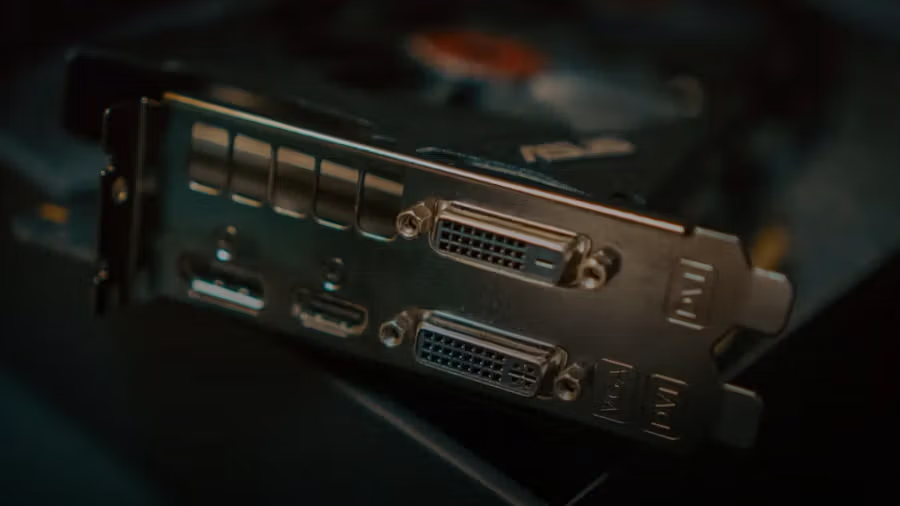
Hardware costs in mid-2026:
| Hardware | Price | VRAM / Memory | Power Draw (Inference) | Typical tok/s (70B Q4) |
|---|---|---|---|---|
| RTX 4090 | ~$1,600 | 24GB GDDR6X | ~350-400W | 30-60 tok/s |
| RTX 5090 | ~$2,000 | 32GB GDDR7 | ~350-450W | 45-80 tok/s |
| Mac Studio M4 Ultra | ~$4,000-$7,000 | 128-192GB unified | ~60-90W | 40-70 tok/s |
| Secondhand A100 (80GB) | ~$6,000-$10,000 | 80GB HBM2e | ~250-300W | 80-120 tok/s |
| Mac M2 Ultra | ~$3,000-$4,500 | 192GB unified | ~60W | 25-50 tok/s (70B) |
Electricity math (often underestimated):
An RTX 4090 drawing 400W under load at the US average of ~$0.13/kWh costs approximately $0.052/hour to run. Running inference 8 hours a day, 30 days a month = $12.48/month. Running 24/7 for a production workload = $38/month. For an Apple Silicon Mac drawing 75W, that drops to $7.02/month at 24/7 operation.
The amortization formula in practice:
Take an RTX 4090 at $1,600, amortized over 24 months:
- Monthly hardware cost: $66.67
- Monthly electricity (8 hrs/day): $12.48
- Monthly maintenance/time overhead (conservative): $25
- Total monthly local cost: ~$104
If you're generating 100M tokens per month at 45 tok/s average, your effective local rate is: (104 ÷ 100,000,000) × 1,000,000 = $1.04/1M tokens
Compare that to GPT-4o's blended $13/1M and the answer is obvious. Compare it to GPT-4o-mini's $0.51/1M and suddenly local hosting doesn't win at that volume. The workload type determines everything.
Is It Cheaper to Run a Local LLM or Use an API?
The answer depends entirely on three variables: your monthly token volume, which model tier you need, and which workload type you're running. There is no universal answer, which is why every Reddit thread on r/LocalLLaMA about this topic devolves into arguments. Let me break it down by workload.
Workload Type 1: Coding Assistant (Low Volume, Latency-Sensitive)
A typical coding assistant workflow — think Cursor at $20/month or a custom setup with Claude — generates roughly 30-80M tokens per month for an active developer. The token mix skews heavily toward output (code completions, explanations, refactors).
At 50M tokens/month against GPT-4o ($13/1M blended), you're spending ~$650/month on API calls. An RTX 4090 at $104/month total cost breaks even in under 3 months. That's a clear win for local.
But here's what the vibes-based analyses miss: if you're using GPT-4o-mini ($0.51/1M blended) instead, your monthly API bill is only ~$25.50. At that rate, an RTX 4090 never breaks even unless you're running well over 200M tokens/month. And a Cursor Pro subscription at $20/month flat-rate is cheaper than both.
The coding workload decision tree:
- Under $50/month API spend: Stay on cloud. The convenience isn't worth the hardware investment.
- $50-$200/month: Consider the managed open-weight API tier first.
- $200+/month: Self-hosting on an RTX 4090 or Apple Silicon Mac breaks even in 3-8 months.
I've been running local models for my own coding workflow for months now, and one thing surprised me: the quality gap between a well-quantized local 70B model and cloud APIs has essentially vanished for code completion and refactoring tasks. Where cloud still wins is complex multi-file reasoning across large codebases.
If you’re weighing Q4 vs Q8 vs FP16 and trying to map that to real quality and throughput, I broke down the tradeoffs (and where each format actually fits) in GGUF vs GPTQ vs EXL2: LLM Quantization Compared [2026]. It’s the missing piece that makes the break-even math line up with what you’ll run in Ollama or llama.cpp day-to-day.
Workload Type 2: RAG Pipeline (Medium Volume, Mixed Latency)
RAG (Retrieval-Augmented Generation) pipelines are where the math gets interesting. A production RAG system handling thousands of queries daily can easily burn through 200-500M tokens per month, with a more balanced input/output ratio (roughly 2:1 output-to-input for typical Q&A).
When I built the Walmart conversational commerce chatbot handling millions of queries daily, retrieval quality dominated answer quality far more than model choice. That experience taught me something directly relevant here: for RAG workloads, you can often use a smaller, faster local model (7B-13B) without meaningful quality loss, because the retrieval step does the heavy lifting. This dramatically changes the hardware requirements — a 7B model runs comfortably on consumer hardware at 60-100 tok/s.
At 300M tokens/month on Claude 3 Haiku ($1.05/1M blended), your monthly API bill is ~$315. An RTX 4090 running a 7B model at $104/month breaks even in month 2. Even a Mac Mini M4 at ~$60/month total cost (cheaper hardware, lower power draw) pays for itself in 3 months.
But Awaliyatul Hikmah, a software engineer, documented a critical gotcha: naive optimization of LLM pipelines can backfire. Her batching experiment reduced API calls by 33% but increased total cost by 37% — because output tokens ballooned from 2,506 to 4,541 with a 71.43% fallback/retry rate. The lesson applies equally to local hosting: your cost model must include retry overhead and failed generations, not just first-pass throughput.
Workload Type 3: Batch Processing (High Volume, Latency-Tolerant)
Batch processing — document summarization, data extraction, classification at scale — is where self-hosting wins most decisively. Volumes often exceed 500M-1B+ tokens per month, latency doesn't matter, and you can run GPUs at full utilization 24/7.
At 1B tokens/month on GPT-4o-mini ($0.51/1M blended), you're still spending $510/month. An RTX 4090 running 24/7 at $104/month pays for itself in month 1. Two RTX 4090s for throughput parallelism still break even in month 2.
For batch workloads, the hardware utilization rate is everything. A GPU sitting idle 20 hours a day during a coding workload has very different economics than one running batch jobs continuously. This is why I always tell developers to calculate their actual monthly token volume before making the decision.
Hardware Options Compared: RTX 4090 vs Mac M-Series vs A100
Not all hardware is equal for local inference. The right choice depends on your model size requirements, power budget, and whether you need the machine for other tasks.
| Dimension | RTX 4090 | RTX 5090 | Mac M4 Ultra | Secondhand A100 |
|---|---|---|---|---|
| **Price** | ~$1,600 | ~$2,000 | ~$4,000-$7,000 | ~$6,000-$10,000 |
| **Memory** | 24GB GDDR6X | 32GB GDDR7 | 128-192GB unified | 80GB HBM2e |
| **Max model (Q4)** | 70B (tight) | 70B (comfortable) | 120B+ | 70B FP16 / 140B+ Q4 |
| **Inference speed (70B Q4)** | 30-60 tok/s | 45-80 tok/s | 40-70 tok/s | 80-120 tok/s |
| **Power draw** | 350-400W | 350-450W | 60-90W | 250-300W |
| **Monthly electricity (24/7)** | ~$38 | ~$42 | ~$8.50 | ~$28 |
| **Monthly amortized (24mo)** | $67 | $83 | $167-$292 | $250-$417 |
| **Best for** | Single-GPU coding/RAG | Larger models, future-proof | Silent operation, huge models | Production throughput |
| **OS/ecosystem** | Linux/Windows, CUDA | Linux/Windows, CUDA | macOS, MLX/Metal | Linux, CUDA |
From maintaining this site's local LLM benchmark database, I've learned that unified memory changes the VRAM-is-the-limit intuition. Big models load on Apple Silicon, but throughput is the real trade-off. A Mac M4 Ultra can load a 120B parameter model that would require multiple NVIDIA GPUs, but it won't generate tokens as fast as a single A100 running a model that fits in its 80GB HBM.
For most developers, the RTX 4090 remains the price-performance sweet spot in mid-2026. The RTX 5090's extra 8GB of VRAM (32GB vs 24GB) matters specifically if you want to run 70B models at Q8 quantization instead of Q4 — a meaningful quality upgrade that I cover in the quantization guide. For a deeper hardware comparison, see the complete local LLM hardware guide.
If you’re considering Intel’s newer GPUs as an alternative to the usual NVIDIA/Mac options, I ran the numbers in Intel Arc B‑Series Local LLM Benchmark [2026]: Arc Done Right. It’s a reproducible harness (TTFT, tok/s, VRAM, power) plus a compatibility matrix and Arc-friendly GGUF quant picks for 8K context.
What Are the Hidden Costs of Running a Local LLM?
Every break-even calculator that only counts hardware + electricity is lying to you by omission. Here are the costs that don't show up on a receipt:
Setup and configuration time. Getting Ollama or vLLM running, choosing the right quantization, tuning context lengths, and setting up monitoring takes 4-16 hours for a competent engineer. At $100/hour loaded cost, that's $400-$1,600 of invisible investment. For production setups, multiply by 3x for hardening, monitoring, and failover.
If your setup path is Ollama-first, I wrote up a concrete end-to-end walkthrough in Ollaya Ollama Decision Model Setup [2026]: Routing + Benchmarks, including how to phrase safe routing questions, wire the TypeSafe SDK to localhost, and measure warm/cold p50/p95 latency.
Model management overhead. New model versions drop weekly. Testing, downloading (70B models are 35-40GB each), and validating replacements is ongoing work. I estimate 2-4 hours per month for a serious local setup.
No SLA or uptime guarantee. When your GPU fails or your Mac kernel panics, your inference is down. Cloud APIs have SLAs (even if they sometimes violate them). If you're running a production AI system that needs 99.9% uptime, you need redundant hardware — which doubles your capital cost.
Opportunity cost of VRAM. That RTX 4090 dedicated to LLM inference can't simultaneously train models, run game development, or handle other GPU workloads. For developers who use their GPU for multiple purposes, the effective cost is higher than pure amortization suggests.
Software ecosystem gaps. Cloud APIs give you prompt caching, usage analytics, rate limiting, and abuse detection out of the box. Replicating these locally means more engineering time. The experience I gained building the AI platform at Firework taught me that the AI feature's bill is dominated by retries and regeneration, not first-pass tokens. This applies to local inference too — you still burn electricity and GPU cycles on failed generations.
A realistic hidden-cost multiplier is 1.2x to 1.4x on top of raw hardware + electricity. Factor that into your break-even math.
The Middle Tier: Managed Open-Weight APIs as a Stepping Stone
This is the option nobody talks about in "local vs. cloud" debates, and it's often the right answer.
Managed open-weight API providers like Deepinfra, Groq, and Together.ai run open-source models (Llama 4, DeepSeek V3.2, Mistral) on their own infrastructure and charge per-token — but at rates far below OpenAI or Anthropic. Llama 3.1 8B on Deepinfra costs $0.09/1M for both input and output. DeepSeek V3.2 on OpenRouter costs $0.1145/1M blended, according to Don Johnson's cost modeling, with a quality score of 77 — the best cost-per-quality ratio among open-weight models tested.
The three-tier decision framework:
- Tier 1: Managed proprietary APIs (OpenAI, Anthropic, Google). Best for: low-volume, highest-quality needs, teams that can't spare engineering time. Monthly spend threshold to move down: $200+/month.
- Tier 2: Managed open-weight APIs (Deepinfra, Groq, Together.ai, Fireworks). Best for: medium-volume workloads, cost-sensitive teams, stepping stone before hardware investment. You get 80-95% of frontier quality at 10-50x lower cost. Monthly spend threshold to move down: $300+/month.
- Tier 3: Fully local (Ollama, vLLM, llama.cpp on your own hardware). Best for: high-volume batch processing, privacy-critical workloads, teams with GPU hardware already available. The self-hosted AI tools ecosystem is mature enough in 2026 to make this viable.
The emerging best deal, as Don Johnson notes, is DeepSeek V4 Flash on Fireworks at $0.0896/1M blended — the cheapest in the field. At that price, even a high-volume batch workload processing 1B tokens/month costs only $89.60. Your RTX 4090 needs to amortize below $0.09/1M to compete, which requires roughly 1.2B+ tokens/month. That's a high bar.
When Privacy and Compliance Tip the Decision
Sometimes the break-even math is irrelevant because the decision is made for you by non-cost factors.
If you're sending proprietary source code to cloud APIs, you're accepting data leakage risk. Cursor offers a privacy mode that prevents your code from being used for training, but the data still transits Cursor's servers. For companies with strict IP policies, defense contractors, healthcare applications under HIPAA, or financial services under SOC 2 — local inference isn't a cost optimization. It's a compliance requirement.
Developer "session limit fatigue" is a real driver of local AI adoption in 2026. The Dev.to community documented a case where a developer's commit message auto-generated as "You've hit your session limit" — cloud API rate limits and costs are actively disrupting developer workflows. When your tools stop working mid-flow because of rate limits or budget caps, the cost isn't just dollars. It's flow state, context switching, and missed deadlines.
For AI security-sensitive applications, local inference eliminates an entire class of prompt injection attack vectors that rely on intercepting API traffic.
Quantization Trade-Offs: Quality vs. Cost in Local Inference
Quantization is the variable that makes or breaks local LLM economics, and most break-even analyses ignore it entirely.
A 70B parameter model at FP16 (full precision) requires ~140GB of VRAM — far beyond any single consumer GPU. At Q4 quantization (4-bit), the same model compresses to ~35GB and fits on a single RTX 5090 with room for context. But Q4 isn't free: you lose approximately 5-10% benchmark performance versus FP16, with the degradation being model-family-specific.
From running the benchmarks on this site, I've learned that quantization quality cliffs are model-family-specific. A blanket Q4 recommendation is wrong. Some model families (DeepSeek, Llama) hold up well at Q4_K_M, while others (some Mistral variants) show noticeable degradation. The GGUF vs GPTQ vs EXL2 format choice also affects quality and speed.
For the cost model, quantization affects the equation in two ways:
- Hardware requirements: Q4 fits on cheaper hardware ($1,600 RTX 4090) vs. Q8 needing more VRAM ($2,000 RTX 5090 or $4,000+ Mac). Lower hardware cost = faster break-even.
- Quality-adjusted cost: If Q4 quantization causes 10% more retries due to lower output quality, your effective token cost increases by 10%. Don Johnson's cost-per-quality metric is the right framework here — $0.1145/1M at quality 77 beats $0.0896/1M at quality 60.
The practical guidance: start with Q4_K_M for experimentation, test on your actual workload (not generic benchmarks), and upgrade to Q6 or Q8 only if you measure a quality gap on your tasks.
The 2026 Break-Even Calculator: Apply This to Your Stack
Here's the decision model you can apply right now. I've built a version of this into the cost calculator tools on this site, but the logic is simple enough to run in any spreadsheet.
Step 1: Calculate your monthly token volume. Track your API usage for one month. Most providers show this in their dashboard. If you're on a flat-rate tool like Cursor, estimate based on sessions: a heavy coding day generates roughly 500K-2M tokens.
Step 2: Determine your blended $/1M rate. Don't use input prices alone. Weight by your actual output-to-input ratio. For coding: assume 4:1 output. For RAG Q&A: assume 2:1. For batch extraction: assume 1:1.
Step 3: Calculate your monthly API spend. Monthly tokens × blended rate ÷ 1,000,000 = monthly cost.
Step 4: Calculate your monthly local cost. Hardware ÷ 24 months + electricity + $25 maintenance overhead.
Step 5: Find your break-even volume. Set monthly local cost equal to monthly API cost and solve for tokens. If your actual volume exceeds this number, self-host. If not, stay on the API.
Quick reference break-even thresholds (RTX 4090, $104/month total local cost):
| Cloud API | Blended $/1M | Break-even at tokens/month | Break-even period |
|---|---|---|---|
| GPT-4o | $13.00 | 8M | 1-2 months |
| Claude 3 Haiku | $1.05 | 99M | 4-6 months |
| GPT-4o-mini | $0.51 | 204M | 8-12 months |
| Gemini Flash 1.5 | $0.255 | 408M | 12-18 months |
| DeepSeek V3.2 (OpenRouter) | $0.1145 | 908M | 18-24+ months |
The table reveals the uncomfortable truth: if you're already using cheap managed APIs like GPT-4o-mini or DeepSeek V3.2 via OpenRouter, local hosting only makes financial sense at very high volumes (200M+ tokens/month). The strongest case for self-hosting in 2026 isn't against cheap APIs — it's against expensive ones like GPT-4o or Claude Opus, or when privacy requirements eliminate cloud as an option entirely.
What Changed in 2026 That Resets the Math
Five developments in 2025-2026 have fundamentally shifted the local vs. cloud equation compared to analyses from even 18 months ago:
- API price compression at the bottom. GPT-4o-mini at $0.15/1M input and Gemini Flash at $0.075/1M input made cloud dramatically cheaper for low-volume workloads. This raised the break-even threshold for local hosting.
- The RTX 5090 and Apple M4 Ultra. 32GB VRAM at $2,000 (RTX 5090) means 70B models at Q4 now fit comfortably on a single consumer GPU. The M4 Ultra with 192GB unified memory loads models that previously required multi-GPU setups costing $10,000+. This lowered the hardware cost floor.
- Open-weight model quality caught up. Llama 4 and DeepSeek V3.2 now rival GPT-4o on coding benchmarks. According to Artificial Analysis, which tracks 548+ models, the quality delta between frontier proprietary models and the best open-weight alternatives has compressed to single-digit percentages on most practical tasks.
- Managed open-weight APIs created a middle tier. DeepSeek V3.2 at $0.1145/1M blended on OpenRouter and DeepSeek V4 Flash at $0.0896/1M on Fireworks means you can get near-frontier quality at prices that compete with local hardware economics. This option simply didn't exist at these price-quality ratios in 2024.
- Hosted inference speed set a high bar. Mercury 2 achieves 1,029 output tokens per second in hosted inference. A consumer RTX 4090 running Llama 3 70B at Q4 typically achieves 30-60 tok/s. That's a 17-34x speed gap. For latency-sensitive applications like interactive coding, cloud still has a meaningful edge — which is why the latency benchmarks matter as much as cost.
The net effect: the break-even threshold has risen for developers using cheap managed APIs, but fallen for developers using premium APIs or needing privacy. The middle has hollowed out — which is why the three-tier decision framework matters more than a binary local-vs-cloud choice.
How Much Does It Cost to Run Llama Locally Per Month?
Let's run the specific numbers for the most common local setup in 2026: Llama 3 70B Q4 on an RTX 4090 via Ollama.
- Hardware: RTX 4090 at $1,600, amortized over 24 months = $66.67/month
- Power: 400W × 8 hours/day × 30 days × $0.13/kWh = $12.48/month
- Maintenance: Model management, updates, monitoring = ~$25/month
- Total: ~$104/month
At 45 tok/s average throughput, running 8 hours a day generates approximately: 45 tok/s × 3600 × 8 = 1,296,000 tokens/day = ~38.9M tokens/month
Effective cost: $104 ÷ 38.9 × 1 = ~$2.67/1M tokens at partial utilization.
Running 24/7 (batch processing or production RAG): 45 tok/s × 86,400 = 3,888,000 tokens/day = ~116.6M tokens/month
Electricity jumps to ~$38/month, total to ~$130/month. Effective cost: ~$1.11/1M tokens at full utilization.
Is Ollama free for production? The software itself is open-source and free. But "free" ignores every cost above. The real question is whether $1.11/1M tokens beats your current API rate. Against GPT-4o ($13/1M) or Claude Haiku ($1.05/1M), the answer is clearly yes and roughly break-even, respectively. Against DeepSeek V3.2 on OpenRouter ($0.1145/1M), local Llama actually costs 10x more per token at 116M tokens/month.
The dirty secret of local LLM cost analysis: at moderate volumes, the cheapest managed open-weight APIs are often cheaper than local hosting. Local only wins decisively at high volumes (500M+ tokens/month) or when non-cost factors like privacy dominate.
The Decision That Actually Matters
Stop asking "is local cheaper than cloud?" It's the wrong question. The right question is: "At my specific token volume, workload type, and privacy requirements, which tier of the three-tier stack minimizes total cost of ownership while meeting my quality bar?"
Here's my prediction for the rest of 2026: the managed open-weight API tier will eat both extremes. Prices will continue compressing toward $0.05/1M blended, making self-hosting economically rational only for the highest-volume workloads (1B+ tokens/month) or privacy-mandated use cases. Meanwhile, premium proprietary APIs like GPT-4o and Claude Opus will remain relevant only for the hardest reasoning tasks where open-weight models genuinely can't compete.
The developers who'll waste the most money are the ones who make this decision based on vibes — either the "cloud is always easier" crowd overpaying by 10-100x on high-volume workloads, or the "self-host everything" crowd spending $4,000 on a Mac Studio to process 20M tokens a month that would cost $2.29 on DeepSeek via OpenRouter.
Run the math. Use the calculator. Your break-even point is a number, not an opinion.
Photo by GAMERCOMP.RU on Unsplash.
Continue reading

vLLM vs Ollama 2026: Production Power or Developer Ease?
vLLM wins for high-throughput production deployments where every token/second counts; Ollama wins for local developer workflows where setup speed and portability matter most. Pick wrong and you'll either over-engineer a side project or under-power a real API.

How to Build a Local Model Registry for GGUF [2026]
Stop downloading random weights from links. Build a local model registry with GGUF versioning, provenance attestations, eval gates, and a real rollback plan.
How to Tell If You Need an AI Agent or a Workflow (7 Smells) [2026]
Most “AI agents” in production are deterministic workflows wearing an LLM costume. Here’s the teardown rubric I use to simplify designs, cut cost, and make on-call sane.
![ollama terminal macbook laptop screen — illustration for article on Ollaya Ollama Decision Model Setup [2026]:](https://img.kunalganglani.com/images/vzekdneq/production/a6ede8c9d4b1546ce5b4e28f601f2cf78d2b4815-1200x675.webp?auto=format&fit=max&q=75&w=500)
Ollaya Ollama Decision Model Setup [2026]: Routing + Benchmarks
Set up Ollaya locally, write safe routing questions, point the TypeSafe SDK at localhost, and benchmark p50/p95 (warm + cold) vs LLM JSON routing.

Kunal Ganglani (2026, July 8). Local LLM Cost vs Cloud API: 2026 Break-Even Math [Calculator]. Kunal Ganglani. Retrieved October 6, 2026, from https://www.kunalganglani.com/blog/local-llm-cost-breakeven
Frequently Asked Questions
Is it cheaper to run a local LLM or use an API?
It depends on your monthly token volume and which API you're comparing against. Self-hosting on an RTX 4090 costs roughly $104/month all-in. That breaks even against GPT-4o at just 8M tokens/month, but against GPT-4o-mini you'd need 204M+ tokens/month. For most developers under 100M tokens/month using cheap APIs, cloud is still cheaper.
How do I calculate the cost of running a local LLM per million tokens?
Add your monthly hardware amortization (purchase price ÷ 24 months) plus monthly electricity (watts × hours × $/kWh) plus maintenance overhead (~$25/month). Divide that total by your monthly token output, then multiply by 1,000,000. For an RTX 4090 generating 100M tokens/month, that works out to roughly $1.04 per million tokens.
What GPU do I need to run a local LLM cost-effectively in 2026?
The RTX 4090 (24GB, ~$1,600) remains the price-performance sweet spot for most developers in 2026. It runs 70B parameter models at Q4 quantization at 30-60 tokens/second. The RTX 5090 (32GB, ~$2,000) adds headroom for larger models or higher quantization. Apple Silicon Macs with unified memory are best for loading very large models quietly.
How much electricity does running a local LLM use?
An RTX 4090 draws roughly 350-400W under LLM inference load. At the US average of $0.13/kWh, that costs about $0.05/hour, $12.50/month at 8 hours/day, or $38/month running 24/7. An Apple Silicon Mac draws only 60-90W, costing $7-9/month even at continuous operation.
What is the break-even point between local LLM and OpenAI API?
Against GPT-4o at ~$13/1M blended tokens, an RTX 4090 setup ($104/month total cost) breaks even at roughly 8M tokens per month — about 2-3 active coding days. Against GPT-4o-mini at $0.51/1M blended, you need 204M+ tokens/month. The break-even varies dramatically by which API tier you're comparing against.
What are the hidden costs of running a local LLM?
Beyond hardware and electricity, expect 4-16 hours of initial setup time, 2-4 hours/month of model management, no uptime SLA (hardware failures take down your inference), and the opportunity cost of dedicating GPU hardware to inference. A realistic multiplier is 1.2x to 1.4x on top of raw hardware + electricity costs.