Vibe Coding vs Agentic Coding: 2026 Decision Guide
Vibe coding is prompt-and-pray with no review. Agentic coding is planned, tool-using, and reviewed. Here's the real technical line and a decision framework for when each one belongs on your team.


Vibe Coding vs Agentic Coding: 2026 Decision Guide
A product manager asks for a throwaway prototype by Friday. The same week, a senior engineer asks who is going to review the 4,000-line diff an agent just opened against the payments service. Same company, same tooling, two completely opposite right answers. Most teams in 2026 are still running one workflow for both, and that is exactly how you end up with unreviewed AI output sitting in a regulated codebase.
Choosing between vibe coding vs agentic coding is no longer a taste debate for hobbyists. It is becoming a policy decision engineering leads have to write down. IBM updated its own explainer on this (authored by Anna Gutowska) as recently as October 28, 2026, formalizing a three-tier spectrum that most content, Wikipedia included, still has not caught up to. The stakes are concrete. Pick the loose workflow for critical code and you ship security holes. Pick the heavyweight one for a weekend spike and you burn tokens and hours you did not need to spend.
I have shipped compliance tooling and I maintain a live LLM pricing tracker on this site, so I care about both ends of this tradeoff. Here is the technical line between the two, and a framework for deciding which to reach for.
Key takeaways
- Vibe coding means prompting for code and accepting it without line-by-line review; agentic coding means orchestrating an agent that plans, uses tools, and produces output you still review.
- IBM frames AI-assisted coding as a spectrum with a third tier, agentic engineering, which treats agent systems as production-grade software with reliability and observability.
- Vibe coding is fine for prototypes, demos, and personal tools. It is a bad default for any code that touches production, money, or user data.
- Agentic coding still needs human code review. The agent does more autonomous work, but the accountability gate does not move.
- Search demand tells the story: roughly 4,161 monthly searches for "vibe coding" versus about 95 for "agentic coding," per the keyword data I track for this site. Most people arrive knowing the fun term and not the disciplined one.
What Is Vibe Coding? (Definition and Origin)
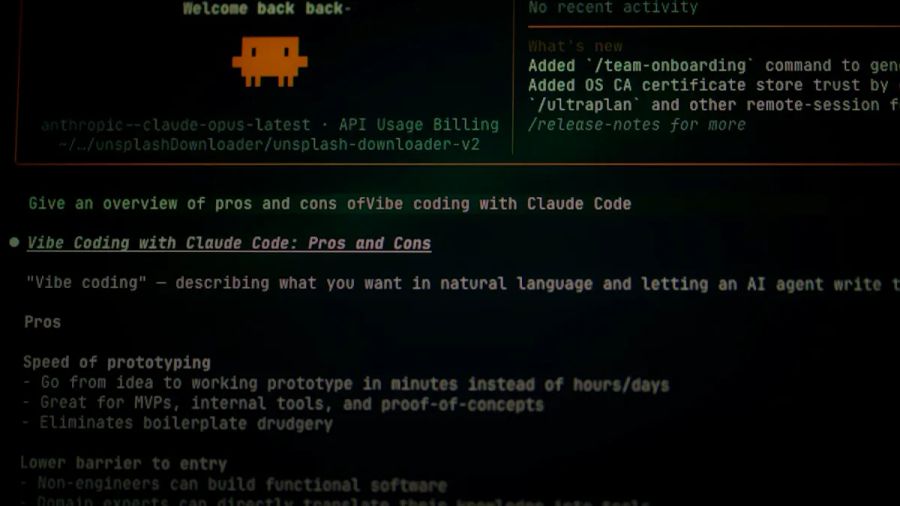
Vibe coding is the practice of building software by describing what you want in natural language and accepting the AI-generated code without reviewing it line by line. The term was coined in February 2025 by Andrej Karpathy, co-founder of OpenAI and former AI lead at Tesla, who described a flow where you "fully give in to the vibes" and barely read the diffs. It prioritizes speed and exploration over structure.
The phrase went mainstream fast. Merriam-Webster listed it as "slang & trending" in March 2025, and Collins English Dictionary named it Word of the Year for 2025. That is why top-of-funnel demand is so lopsided toward the term.
The defining feature is not the tool. It is the absence of review. Simon Willison made this point sharply: if you review the code, understand it, and take responsibility for it, you are just using an AI assistant, not vibe coding. The moment you stop reading the output and start trusting the vibes, you have crossed the line. That distinction matters because it is the one your code-review policy actually hinges on.
Tools in the vibe coding lane include anything optimized for fast prompt-to-output with minimal friction: the chat panes in Cursor and Windsurf, the original autocomplete mode of GitHub Copilot, and the growing set of "build me an app" web tools. GitHub Copilot, announced in June 2021 by GitHub and OpenAI, started life as exactly this kind of lightweight, low-review autocomplete years before anyone bolted agent features on top.
What Is Agentic Coding? (Definition)
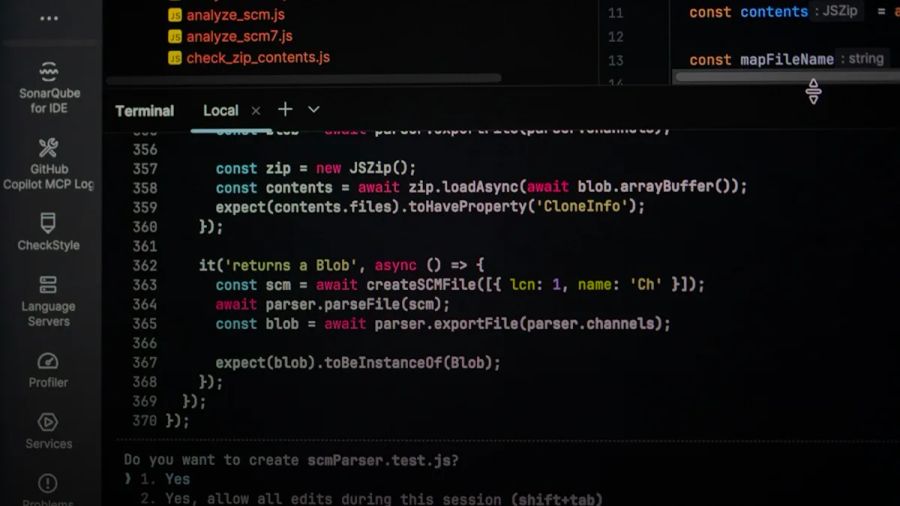
Agentic coding is a workflow where a developer directs an AI agent that plans a task, uses tools to execute it across multiple steps, and produces testable code the developer then reviews. The key difference from vibe coding is the scaffolding: planning, tool use, and multi-step execution instead of a single prompt and a single blob of text.
That scaffolding is real engineering. An agentic system has a harness, orchestration logic, and access to your actual environment through tools. The infrastructure that makes this work is the Model Context Protocol (MCP), introduced by Anthropic in November 2024, adopted by OpenAI and Google DeepMind, and donated to the Agentic AI Foundation under the Linux Foundation in December 2025. MCP standardizes how a model connects to repos, APIs, and execution environments. That tool access is the technical feature vibe coding fundamentally lacks.
Vibe coding is defined by what it skips: the review. Agentic coding by what it adds: a plan, tools, and a diff you still own.
Devin AI, built by Cognition Labs, is the reference example people reach for: an agent designed to autonomously plan and execute multi-step development tasks rather than answer one prompt. In day-to-day work, Claude Code, Cursor's agent mode, GitHub Copilot's agent mode, and OpenAI's Codex CLI all operate in this lane. If you want the deeper mechanics of what makes a system agentic rather than just a chat box, the AI agents pillar goes into harness and agent orchestration in detail.
The Spectrum: Vibe Coding to Agentic Coding to Agentic Engineering
IBM's most useful contribution is refusing to treat this as a binary. Anna Gutowska's framing puts AI-assisted coding on a three-point spectrum, and the third point is the one everybody skips.
Vibe coding sits at the informal end: natural-language prompts, speed over structure, little or no review. Agentic coding introduces discipline. You orchestrate agents with defined roles and constraints to produce testable, iterable code. Agentic engineering goes further still, treating these agent systems as production-grade software with real system design, reliability guarantees, and observability. It is the difference between asking an agent to fix a bug and building the pipeline, guardrails, and monitoring that let agents safely touch your codebase at scale.
Most searchers conflate the last two. The simple test: agentic coding is how you produce code with an agent, agentic engineering is how you engineer the agent system itself. One is a workflow. The other is a discipline with its own production AI concerns like evals, rollback, and audit trails.
Here is the official IBM Technology breakdown if you want the vendor framing straight from the source:
The reason the spectrum matters more than any single definition: your team will use all three in the same month. The mistake is applying one review policy across all of them.
Vibe Coding vs Agentic Coding vs Agentic Engineering: The Comparison
| Dimension | Vibe Coding | Agentic Coding | Agentic Engineering |
|---|---|---|---|
| Review process | None or glance only | Human reviews every diff | Automated gates plus human review |
| Planning | Single prompt | Agent plans multi-step | System-level design upfront |
| Tool use | Minimal (chat/autocomplete) | Repo, tests, APIs via MCP | Full CI/CD, observability, evals |
| Risk level | High for anything shipped | Moderate, bounded by review | Lowest, but highest build cost |
| Who owns the output | Unclear | The reviewing engineer | The platform team |
| Best use case | Prototypes, demos, personal tools | Features, refactors, internal tools | Production agent pipelines at scale |
This table is the thing I wish IBM's explainer had included. It names the spectrum and then stops at definitions. The decision lives in the columns, not the paragraphs.
Benefits and Risks of Each Approach
Vibe coding's benefit is raw velocity. Think of a throwaway internal dashboard: nobody will maintain it, nobody will extend it, and the worst-case cost of a bug is that you delete the thing and start over. Reading every line there is wasted motion. The risk is that "throwaway" prototypes have a nasty habit of ending up in production, and vibe-coded output carries no accountability, patchy maintainability, and well-documented security exposure.
Agentic coding's benefit is leverage with a safety rail. The agent handles the tedious multi-file plumbing, runs the tests, and comes back with a reviewable diff. The cost is twofold: tokens and attention. A single agent run that explores a large repo, retries failed tests, and rewrites files can burn far more tokens than a one-shot prompt. When I built the cost calculators on my LLM pricing tracker, the clearest lesson was that per-token price comparisons mislead without cache-hit and retry assumptions. Agent loops retry constantly, so their real cost is higher than a naive token count suggests. Budget for the retries, not the happy path.
Agentic engineering's benefit is that agents become a dependable part of your delivery pipeline rather than a party trick. The risk is over-investment. Building observability and eval harnesses for a three-person startup shipping a single app is premature. That tier earns its keep when agents run often enough that their failures cost you real money.
There is a productivity trap worth naming. More autonomous tooling does not automatically mean faster teams, and it can quietly increase review load and burnout if nobody adjusts the workflow. The leverage is real, but it moves work rather than erasing it.
Security and Code Quality Concerns
This is where the vibe coding vs agentic coding choice stops being a preference and becomes a liability question. Critics of vibe coding consistently cite three failure modes: quality and security vulnerabilities from unreviewed code, maintainability debt that compounds silently, and debugging nightmares when nobody on the team understands code they did not read.
The security surface is the sharpest edge. Agentic systems that use tools can be targeted through prompt injection, where malicious content in a file, issue, or dependency hijacks what the agent does with its tool access. An agent with repo write access and shell execution is a far bigger attack surface than a chat box. That is not a reason to avoid agentic coding. It is a reason to run it with scoped permissions and reviewed diffs, which is precisely the discipline vibe coding throws away.
For code quality, the non-negotiable rule is that AI code review does not replace the human gate. Agentic coding still needs human review. The agent writes more autonomously, but the accountability line stays exactly where it was: a named engineer approves the diff and owns what ships. If your policy lets agent output merge without a human owner, you do not have agentic coding. You have vibe coding with extra steps and a larger blast radius.
My strongest conviction here comes from shipping SOC 2-compliant scaffolding tooling at Rise People: compliance baked into scaffolding beats compliance review at PR time. The same logic applies to agents. Encode the constraints (allowed tools, protected paths, required tests) into the harness up front, not into a reviewer's memory at 5pm on a Friday.
Decision Framework: When to Use Each in 2026
Stop choosing a workflow by mood. Choose it by the blast radius of the code. Here is the checklist I would hand an engineering lead writing policy:
- Is the output disposable? Prototype, spike, demo, or a personal tool only you will touch. Use vibe coding. Reading every line is waste. Just do not let it graduate to production without a rewrite pass.
- Does it touch a shared internal codebase but not production or user data? Use agentic coding with mandatory diff review. Internal tools, refactors, test scaffolding, migrations. Let the agent plan and execute, but a human approves the merge.
- Does it touch production, money, auth, or regulated data? Agentic coding with full review gates, scoped tool permissions, and required passing tests. No unreviewed merges, ever. This is the line where vibe coding is simply the wrong tool.
- Are agents running often enough that their failures cost real money? Invest in agentic engineering: evals, observability, rollback, and audit logs for what agents changed and why.
- Is your team larger than a handful of engineers? Write the policy down. Define who approves agent-generated diffs and which paths agents may touch. Ambiguity is how unreviewed code sneaks into main.
Can vibe coding and agentic coding coexist on one team? Yes, and they should. The best 2026 teams let people vibe-code freely in sandboxes and prototypes while enforcing agentic discipline the moment code heads toward production. The failure mode is not using both. It is using one policy for both. Map your tools to the tiers too: Cursor chat and Copilot autocomplete for the vibe lane, Claude Code and Codex CLI in agent mode for the disciplined lane, and dedicated platform tooling for the engineering tier.
Is vibe coding still relevant in 2026, or has agentic coding replaced it? It has not been replaced, and it will not be. Vibe coding is the fastest path from idea to running prototype, and that value does not disappear because agents got better. What has changed is the honesty about where it belongs. The teams that win in 2027 will be the ones that stopped treating this as a tooling choice and started treating it as a review-policy choice. Write that policy before an agent writes something you cannot take back.
Photo by Jefferson Santos on Unsplash.
Continue reading

5 mattpocock/skills That Help You Understand Your App
You shipped an app with AI and can't explain how it works. Here are the exact mattpocock/skills to install first to finally understand your own codebase.

Vibe Coding vs Agentic Coding: 2026 Decision Guide
Vibe coding is fast and low-structure. Agentic coding is planned and tool-using. Here's a scoring rubric for which one wins on your actual project.

OpenCode vs Claude Code Token Overhead: The 4.7x Gap
Claude Code sends 33,000 tokens before reading your prompt. OpenCode sends 7,000. Here's the cache economics, the multiplier stack, and the break-even math for teams.
Vibe Coding Best Practices: 7 That Work, 3 Traps to Avoid
Vibe coding's creator says it's already passé. Here are the techniques that survive the shift to agentic engineering — and the ones silently destroying your codebase.

Kunal Ganglani (2026, November 27). Vibe Coding vs Agentic Coding: 2026 Decision Guide. Kunal Ganglani. Retrieved November 27, 2026, from https://www.kunalganglani.com/blog/vibe-coding-vs-agentic-coding
Frequently Asked Questions
What is the difference between vibe coding and agentic coding?
Vibe coding is prompting for code and accepting it without line-by-line review, prioritizing speed. Agentic coding is directing an AI agent that plans a task, uses tools across multiple steps, and produces code you still review. The core difference is the review gate and the scaffolding of planning and tool use.
Is vibe coding safe for production code?
No. Vibe coding skips review, which means unexamined code can carry security vulnerabilities, maintainability debt, and bugs nobody understands. It is fine for prototypes, demos, and personal tools, but any code touching production, money, authentication, or user data needs reviewed, constrained workflows instead.
What is agentic engineering and how is it different from agentic coding?
Agentic engineering is IBM's third tier: treating agent systems as production-grade software with system design, reliability, observability, and evals. Agentic coding is a workflow for producing code with an agent. Agentic engineering is the discipline of building and operating the agent systems themselves at scale.
Does agentic coding still need human code review?
Yes. The agent does more autonomous work, but accountability does not move. A named human reviews and approves every diff and owns what ships. If agent output can merge without a human owner, that is not agentic coding, it is unreviewed vibe coding with a larger blast radius.
What tools count as vibe coding vs agentic coding tools in 2026?
Vibe coding tools favor fast prompt-to-output with little review: Cursor and Windsurf chat panes, Copilot autocomplete, and web app builders. Agentic coding tools plan and use tools: Claude Code, Cursor and Copilot agent modes, OpenAI Codex CLI, and Devin. Many tools span both depending on the mode you use.
Can vibe coding and agentic coding be used together on the same team?
Yes, and they should. Let engineers vibe-code freely in sandboxes and prototypes, then enforce agentic discipline with mandatory review once code heads toward production. The failure mode is not using both approaches, it is applying a single review policy to both instead of matching the policy to the code's risk.